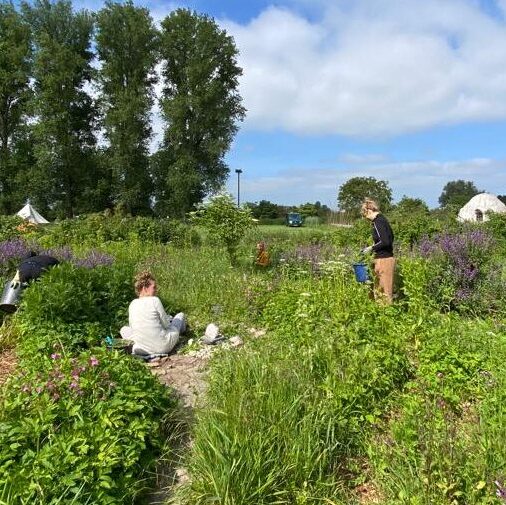
Organic gardening is our passion.
Organic vegetables, fruit, and nuts have been grown at Vlierhof for twenty years. In our beautiful gardens, we think in terms of holistic connection and circular working. Vlierhof is a place we tend together; we do not speak from a place of ownership over our garden—the garden is its own possession. When we speak of our garden, it is from a place of stewardship and love. We do not think about combating pests, but rather about creating balance. Our garden is insect-friendly, with piles of dead wood, overgrown corners, and bird feeders. A wide variety of wild bees, tits, hedgehogs, starlings, tree sparrows, and house sparrows have settled there. Hedges with native shrubs and a large pond create an ideal microclimate, as it is surrounded by sown aquatic plants.
Environment
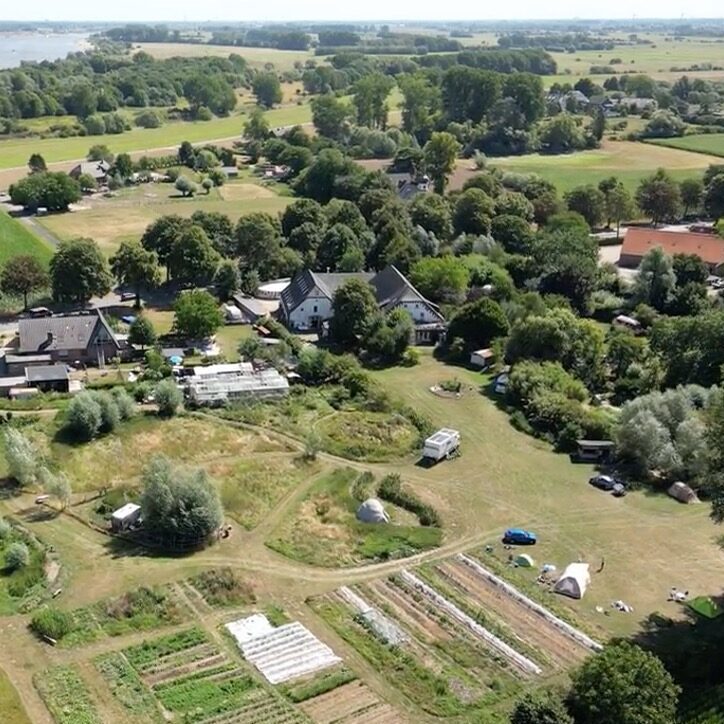
De Vlierhof is located in Germany in the state of North Rhine-Westphalia. Kleve is the nearest major city in Germany and Nijmegen the nearest major city in the Netherlands. We live here in the village of Keeken and the municipality of Kleve. The location is close to the river Rhine. The soil on which we are situated is river clay; the minerals in the soil were brought here centuries ago by the glaciers that formed the valley from Berg en Dal to Wageningen. This place has now been a home for over 20 years for people living at De Vlierhof, an ecovillage where we promote peace and consciousness.

Surface
De Vlierhof is a 3-hectare plot of land, of which approximately 1.5 hectares consists of a (vegetable) garden.

Biodiversity
The garden consists of an organic vegetable garden, a fruit orchard, and various strips of grass serving as a meadow and campsite. The entire area is bordered by native wild shrub hedges. There is a herb labyrinth with local wild herbs, and an ornamental garden with fruit bushes, flowers, and plants. The community garden features, among others, large nut trees, cherry trees, and various other fruit trees, the harvest of which we process in the summer and autumn. Although already substantial, we are trying to increase the (bio)diversity in the garden and make it even more attractive to the animals with whom we share the land.
Garden Philosophy
In our garden, we work in harmony with nature. We try to disturb the soil as little as possible (in other words, the no-dig method): https://www.charlesdowding.co.uk/no-dig-worldwide), because we see the value of all life in the soil. We care for the soil because we know that the soil also cares for us. When we enter the garden, we are aware of the bigger picture. How we treat the plants and all the life around us affects the plants and how they care for us. Our relationship with nature is reciprocal. The book Braiding Sweet Grass is one of our sources of inspiration, highly recommended for anyone who is not yet familiar with this book! Central to this book is the idea that we can treat the life around us with reverence. For example, it is important to ask the plant for permission when you want to harvest. Plants have much to tell us; we sometimes forget to listen. It is important to observe closely; this is how we get to know our plants and know what they need because we are connected to them.

Regenerative agriculture
In the vegetable garden, we apply concepts from regenerative agriculture and permaculture. Components of this include restoring the soil, increasing biodiversity, soil resilience to climate fluctuations, and carbon storage in the soil. In practice, this amounts to mulching beds, crop rotation, composting, and the use of ground covers or green weeds. Mulching beds means that beds are protected from drying out, wind, and rain by covering them with organic material such as leaves, grass, compost, or reeds. Crop rotation means that the same crop is never grown in the same spot for two consecutive years. The result of this is that there is less risk of disease and we do not deplete the soil of the same nutrients for the plants. We make compost using all the green and brown material that comes from our land. Branches from pruned trees, weeded plants, food scraps, and manure from the neighboring animal shelter together form the basis of the compost and are transformed into nutrients for the soil and the foundation for new plants. Green manures or cover crops ensure that carbon is stored in the soil and at the same time provide a home for many insects.

Investing in the soil
In our garden, the interplay between soil and plant plays a central role. Green manures can improve the organic matter content and stimulate soil life. Weather permitting, we sow them either a few weeks before the beds are planted or after the first crops have been harvested. Another advantage: Green manures loosen the soil and enrich it with nutrients. Additionally, rock flour or ash is added to all beds in the spring for healthy and vibrant soil. It provides important minerals and trace elements and promotes good soil structure. Furthermore, we use a digging fork to aerate the soil and thereby promote soil life.
GARDEN TEAM | HELP WANTED
Words sometimes fail me
There is so much to say about our garden and the piece of land where we live. Yet these words are an attempt to convey the reality and cannot fully cover the whole picture. If you stop by, you can experience the garden for yourself, with your hands in the earth and your face in the sun. You are very welcome to come by, and we can always make good use of your help, knowledge, or exchange.
Hope to see you soon in the garden <3